Reforms meant to strengthen the empire’s economy unintentionally helped the Czech nation emerge, new study explains
Why do nations emerge? Part of the academic literature describes them as built “from the top down” by ruling elites, for example through schools or propaganda. But how can we explain the emergence of the Czech nation within the Habsburg Monarchy, when the ruling elites had no interest in it whatsoever? In the Journal of Institutional Economics, Lucie Mařanová and Marek Hudík from the Faculty of Business Administration at the Prague University of Economics and Business offer an economic explanation: nations can emerge “from the bottom up”, out of competition for economic and political resources.
When reforms bring groups together
The study’s starting point seems paradoxical at first. A ruler introduces liberalising reforms to promote economic growth and increase revenue. He lowers barriers to market entry, weakens the guilds and makes it easier for people to move for work. In doing so, however, he brings groups that had previously lived apart into direct contact and competition.
People then need a way to succeed in this new competition. A shared language and culture can serve as a natural focal point for agreeing on who belongs to “us”. This gives rise to coalitions based on shared ethnicity that exclude others from access to contested resources, such as jobs, credit or administrative positions. When such coalitions become sufficiently widespread, a nation emerges.
The authors formalised this idea in a theoretical model. According to the model, a nation emerges only if three conditions are met: there is conflict over resources, the population is locally heterogeneous, and shared ethnicity is salient to people. The model distinguishes four possible scenarios, only one of which leads to nation formation. Nation formation is not the aim of the reforms but their by-product.
The Czech story: from the loss of Silesia to Czech savings banks
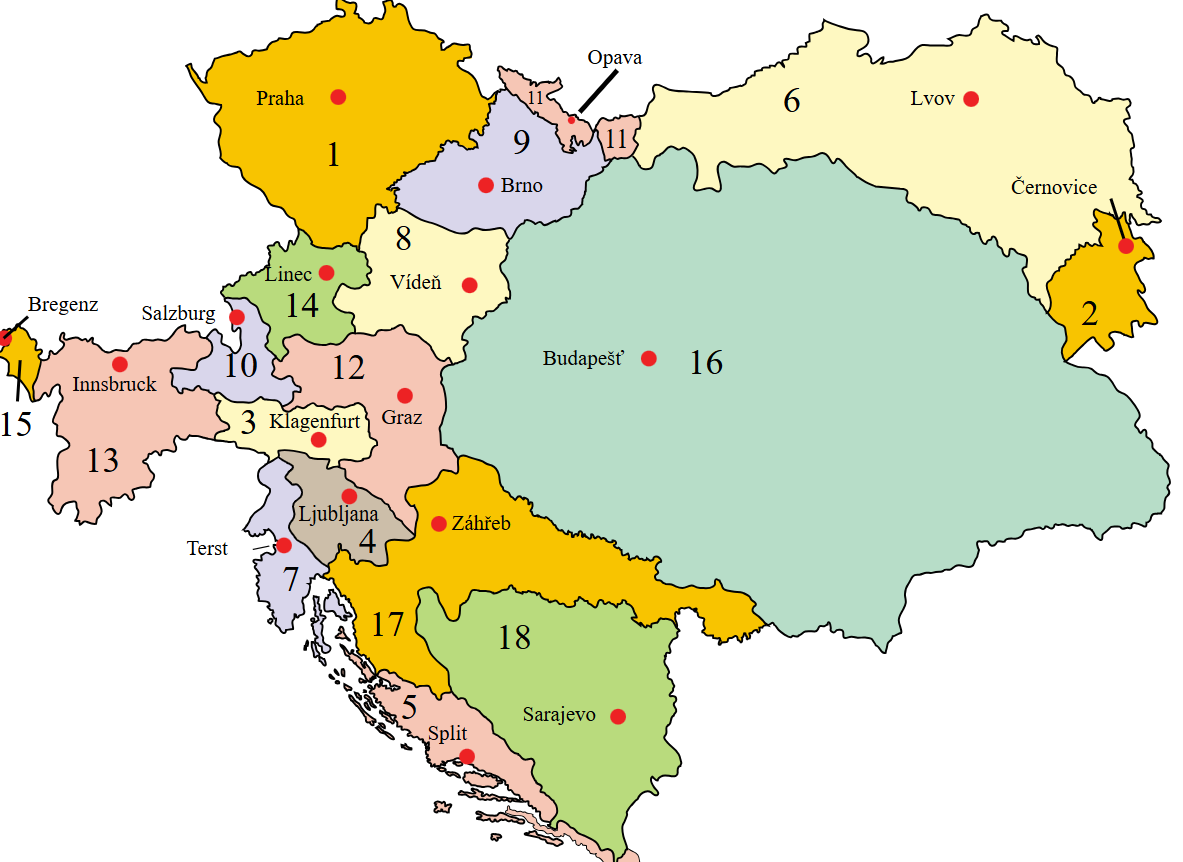
The authors illustrate the model with the emergence of the Czech nation between the late 18th and early 20th centuries. The process began with geopolitical and economic shocks, above all the loss of most of Silesia in the mid-18th century. As a result, the Czech Lands became the new economic powerhouse of the Empire. The monarchy responded with the Theresian and Josephine reforms, followed later by the abolition of serfdom in 1848, constitutional reform and the Trades License Regulation. These reforms made it easier for people to move and to start businesses.
Czech-speaking workers from the countryside began moving into cities where the German-speaking population had previously dominated. They competed for jobs, credit and positions in the state administration, and language became an increasingly important marker of group identity. The ground had been prepared by patriotic scholars in the second half of the 18th century, who revived and developed the Czech language. They created a shared cultural basis on which others could later build.
Access to finance is a telling example. Aspiring Czech entrepreneurs mostly came from modest backgrounds, while the established German and Jewish banks primarily served large, incumbent firms. Czech actors therefore founded their own savings banks, which channelled funds to Czech entrepreneurs. In the terms of the model, this is exactly a coalition based on shared identity that overcomes exclusion from access to resources.
Czechs also gained ground in local government. From the 1880s onward, economic conflicts increasingly spilled over into consumer boycotts and the exclusion of competitors from markets. Consistent with the model, the national movement was strongest in economically developed and culturally mixed regions, for example near the Czech-German language boundary.
As these processes intensified, the cost of maintaining a multiethnic state grew. According to the authors, the collapse of Austria-Hungary and the emergence of an independent Czechoslovakia in 1918 can be understood as the outcome of this long-term development.
Key takeaways
The study shows that even well-intentioned, growth-oriented reforms can unintentionally fuel nationalism by disrupting existing social structures and forcing previously separated groups to compete for resources. The authors also point out that the model is deliberately simplified and captures one specific mechanism. They present the Czech case not as representative of all nationalist movements but as an illustration of this mechanism. In other settings, such as many colonial contexts, different dynamics may prevail.
Study:
Mařanová, L., & Hudik, M. (2026). State-seeking nationalism: the emergence of small nations in multiethnic empires. Journal of Institutional Economics, 22, e39, 1–16. https://doi.org/10.1017/S1744137426100770
The research was supported by the Czech Science Foundation (Grant No. 22-28539S).